AI • Operating Models • Strategy • 2026
AI Won't Fix a Broken Operating Model
Why automating the current mess is not transformation — and why strategy, architecture and execution coherence matter more as AI makes execution cheaper.
Originally published on LinkedIn in February 2026 as Is Your AI Strategy Just a Blue Pill? A Strategic Hypothesis. Edited and updated for jpdferreira.com. View the original ↗
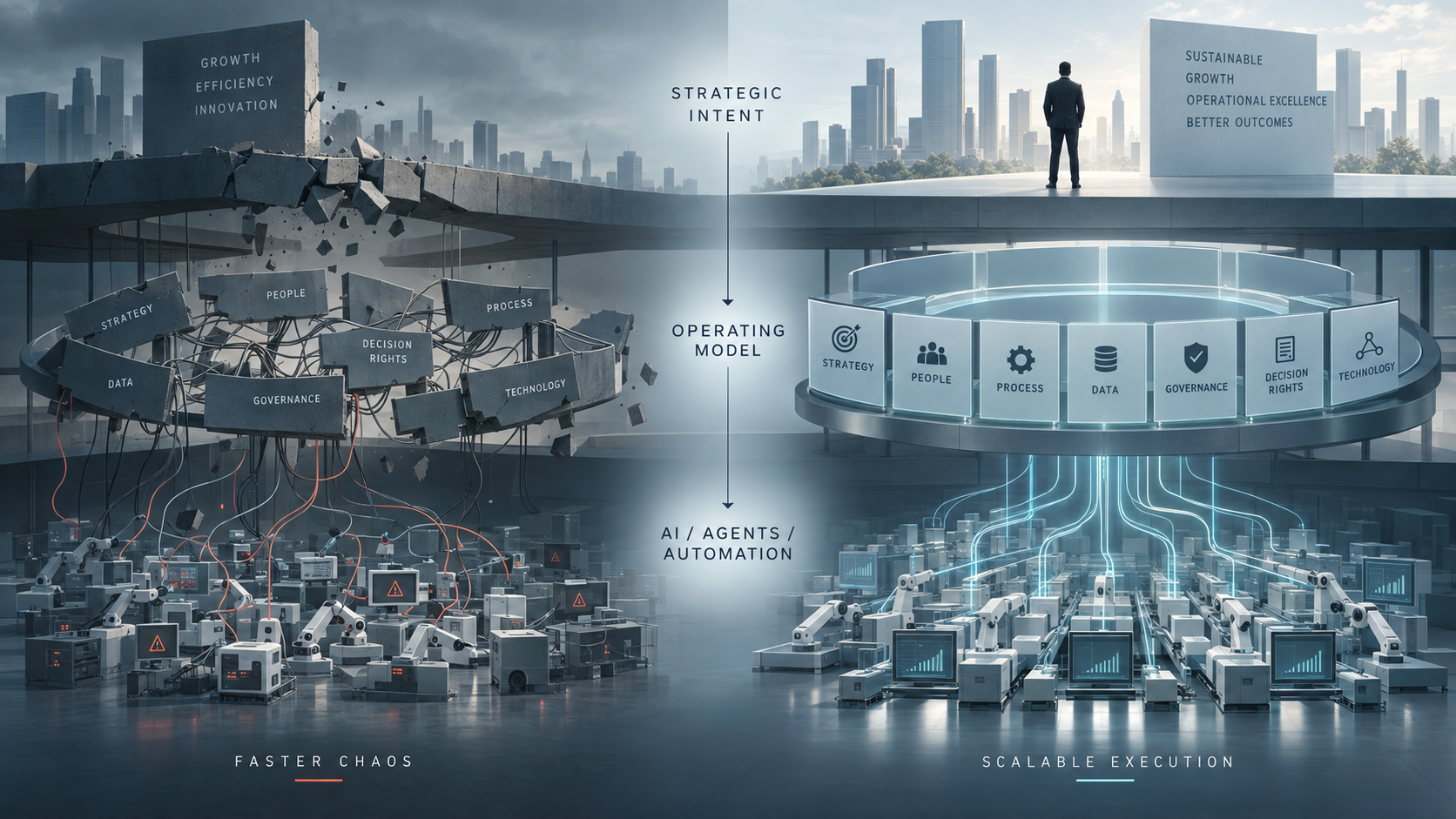
There is a growing tendency for leaders to stare at AI and ask whether it is a silver bullet or simply a faster way of generating noise. We have seen versions of this before — from early automation to big-data hype cycles — and the pattern is familiar.
The uncomfortable possibility is that many organisations are using AI to automate their current mess.
That is the blue pill: preserve the existing operating model, add increasingly capable technology, and hope that the result is transformation.
It rarely works that way. Technology can accelerate a process, but it cannot decide whether the process should exist. It can optimise a workflow, but it cannot resolve contradictory ownership. It can generate information at extraordinary speed, but that does not automatically produce better judgement.
The problem is not access to AI. It is architecture.
Many businesses already have more data and information than they can meaningfully use. The scarce resource is increasingly the ability to connect that information to decisions, operating context and strategic intent.
This creates what I see as an architectural gap between strategy and automated execution.
As AI agents become more capable, three layers become useful to distinguish:
1. AI agents — execution
Increasingly autonomous systems that execute tasks with speed and consistency. They are powerful precisely because execution is becoming cheaper and more abundant.
2. The systems architect — integration
The layer that connects roles, processes, data, decision rights, governance and technology into a coherent operating system. Its job is not to slow execution down, but to ensure the pieces reinforce rather than contradict one another.
3. The strategic pilot — intent
Leadership that determines where the organisation is trying to go, what trade-offs matter, what should be redesigned, and which outcomes are worth optimising in the first place.
The terminology matters less than the underlying point: logic and intent are not the same thing.
AI can optimise a path. It cannot choose the destination for you.
An AI system can become exceptionally good at finding a route once the objective is defined. But organisations are full of competing objectives: speed versus risk, utilisation versus resilience, local performance versus enterprise value, customer customisation versus standardisation.
Those are not merely optimisation problems. They are strategic choices.
The danger appears when automated execution inherits objectives, data structures and workflows that were designed for yesterday's business. The technology may perform exactly as requested while making the organisation more efficient at doing the wrong thing.
This is air-traffic control, not middle management.
One objection to an architectural layer is obvious: does this simply create more bureaucracy? I think the opposite is possible.
A pilot flies the aircraft. Air-traffic control does not fly it for them. It creates the shared structure that allows many independent aircraft to move quickly without occupying the same airspace.
Organisations need something similar as autonomous agents proliferate. Without coherent rules, interfaces and decision rights, adding more agents can increase coordination cost rather than reduce it.
Good architecture should therefore remove the need for unnecessary intervention. It should make autonomy safer and faster.
Execution is becoming cheaper. Problem recognition becomes more valuable.
A more fundamental shift follows from all of this. As machines become increasingly capable of performing the work, the ability to perform a task is less likely to be the scarce resource.
The bottleneck moves upstream: identifying the right problem, understanding the system around it, deciding what should change and designing a coherent future state.
That changes the economics of transformation. When the “doing” becomes easier, knowing what should be done — and how the pieces should fit together — becomes more valuable.
Don't automate the current operating model by default.
This is the question I would put in front of any leadership team developing an AI strategy:
If we designed this company today, knowing what AI can now do, would we build the same roles, workflows, interfaces and management systems?
If the answer is no, then automating the existing process is probably not the transformation. It may only be an intermediate step.
The larger opportunity is to redesign the system: which work remains human, which becomes automated, where judgement belongs, how decisions move, what information matters, which controls are necessary, and how accountability works when humans and machines increasingly operate together.
From AI strategy to a transformation machine
I used the phrase Transformation Machine in the original article. I still like the idea, but I would define it more explicitly today.
It is not a department or a programme. It is an organisational capability for repeatedly connecting:
- strategic intent,
- operating-model design,
- technology and data,
- people and decision rights,
- and execution.
AI becomes powerful inside that system because it amplifies something coherent.
Without it, the organisation may simply acquire increasingly sophisticated tools while the underlying friction remains intact.
The real AI Valley of Death
The Valley of Death for a new technology is not always a lack of tools or technical capability. It is often the gap between what technology makes possible and what the organisation is capable of absorbing.
In the AI era, that gap may become more visible because the technology is improving faster than many operating models can adapt.
The companies that benefit most will not necessarily be those with the largest collection of agents. They will be those able to connect new execution capability to strategy, architecture and human judgement.
AI will not fix a broken operating model. But it may make the cost of leaving it broken impossible to ignore.
João Paulo Dias Ferreira · Transformation & Operations Executive